Showing posts with label open source revolution. Show all posts

Thursday, March 7, 2013

The GitHub Revolution: We’re All In Open Source Now :) We’re Witnessing The Birth Of A New Culture. It Is Less About The Project And More About The Individuals. The System Is Getting Decentralized :D

open source revolution, chnage, edit, people empowerment, decentralization of system

GitHub was intended to be an open software collaboration platform, but it’s become a platform for much, much more than code. It’s now being used by artists, builders, home owners, everyone in between, entire companies … and cities.

GitHub is doing to open source what the internet did to the publishing industry.
The city of Chicago recently announced, “anyone can now change the data when new bike paths are built, when roads are under construction, and new buildings are erected.” People are managing home-renovation projects on GitHub. One law firm also just announced that it’s posting legal documents for early-stage startup funding on GitHub.

Someone even published all of the laws in Germany on GitHub last year. (Perhaps not so surprisingly, he has about 17 open “pull” requests for changes.) And of course, GitHub is still used by programmers and developers flying AR Drones with Node.js or building websites with jQuery.

As people who were once just users become producers, they’re re-shaping the culture of open source. GitHub, I believe, is doing to open source what the internet did to the publishing industry: It’s creating a culture gap between the previous, big-project generation of open source and a newer, more amateurized generation of open source today.

The Revolution Will Not Be Centralized

When most people hear “open” source, they think democratic, distributed, egalitarian: everyone building things together for everyone else to use.

But that hasn’t actually been the case. Most open source software has been created and maintained by a privileged and protected class of people — professional developers — who interacted with other developers that were a lot like them (though were just different enough to have a good argument with).


Mikeal Rogers

Mikeal is the CTO of Getable and the curator of NodeConf. Roger’s long history in open source includes the Open Source Applications Foundation, Mozilla, CouchOne, and numerous projects across different communities.
Before GitHub, I spent a lot of my time thinking and talking about how to best manage open source projects because the coordination cost of an open source project was significant. So significant, in fact, that when a project did well and grew a big enough community, it made more sense for the project to grow rather than fracture into smaller projects. But the bigger and more complex a software project got, the harder it became to contribute. So an assortment of members — or “committers” — were tasked with managing and producing the project.

This often led to rifts between those producing and those consuming a project.

GitHub closed this rift by making open source much more decentralized. It became less about the project and more about the individuals.

The workflow for using GitHub is very personal. A person (I’m github.com/mikeal) has an account, and everything they publish exists one level below them. If someone else wants to fix something, they “fork” it, which puts a copy of it under them.

This workflow is very empowering: It encourages individuals to fix things and own those fixes just as much as they own the projects they start. It also gives all users an identity in the new open source culture; GitHub is actually the number-one identity provider for peer-based production over the internet in more than just code.
I’ve been contributing to open source projects for over 10 years, but what’s different now is that I’m not a “member” of these projects — I’m just a “user,” and contributing a little is a part of being a user. Little interactions between me and the project maintainers happen several times a week on all kinds of little projects I use.

And it happens even more often in the other direction: People I’ve never heard from send me little bits of code on all the little projects I’ve published.

As people who were once just users become producers, they’re re-shaping the culture of open source.

Decentralization as Democracy

The first versions of GitHub did one thing very well: They made it much easier to publish — than to not publish — your code. This was enough for many notable projects, including Ruby on Rails, to move to GitHub almost immediately.

But what happened next was even more interesting: People started publishing just about everything on GitHub…. Pushing code became almost as routine as tweeting. By reducing barriers to entry and making it easier to coordinate and contribute to open source, GitHub broadened the peer production to casual users.
Today a vast landscape of simple and understandable software is accessible to a creative class of people who did not have the depth of technical knowledge necessary to participate in the large open source projects of the past.

This blurring of relationships between producers, contributors, and consumers naturally values smaller and more easily understood projects — and has led to a long tail of contributions. In the entire month of September 2012, for example, half of all active GitHub users who pushed a “changeset” pushed fewer than five changesets, with 22 percent (about 44,000 people) pushing only a single changeset that month.
It became less about the project and more about the individuals.
This amateurization of open source software has some obvious benefits.

Making Things Easier to Use

One of the longtime problems with open source software has been fit and finish. Bad documentation, website design, and usability in general have been poor — especially when compared to many proprietary counterparts.

But now, with low barriers to contribution, less-technical users see these areas as easy places they can improve the very software they rely on. (This means little things like cryptic error messages get more humane and tiny one-line CSS changes make websites render correctly in ancient browsers and mobile phones.)
In the new open source, people want to use technology without having to become an expert in it. Ease of use is valued more than ever.

Preventing Over-Engineering

Engineers love a challenge and the more chances they have to solve it, the more clever their solutions can become. That was okay when the consumers of those solutions were highly technically minded people like them who rejoiced in clever ways to solve old problems.

But amateurs like solutions they can take for granted: Once a problem is solved, they will rarely go back or re-examine it. And because amateurs will only build on top of the most understandable solutions, it forces developers to create simple solutions that make hard problems easy to understand.

Supporting a Broader Ecosystem

Node.js, where I’m actively involved, defines enough simple patterns that people can write small libraries independently and publish at will. Everyone invested in the ecosystem can use that value without any coordination. This is the polar opposite of the big vertical stacks that come with lots of tools and features (such as integrated plugin systems like ember, Dojo, and YUI) that are required for success in proprietary environments (think Cocoa and writing for iOS).

But in open environments, like Node.js on GitHub, we see much smaller API footprints that can easily leverage the rest of the value in the ecosystem without coordination (for example callback APIs in jQuery or node’s standard callback pattern). The less coordination between developers and libraries the more we can create value.

- - -
GitHub has empowered a new generation of people to collaborate, create, produce. Many developers will lament the loss of former cultural norms — like the place of committers or the old fight about which license to use — but the future is already in the hands of a new generation that has moved on.
This isn’t just a tool: We’re witnessing the birth of a new culture.

Source: http://www.wired.com/opinion/2013/03/github/

Learn More Here: https://github.com

This talk introduces the Git Version Control System by looking at what Git is doing when you run the commands you need to do basic version control with it. We'll look at how to use Git to do the basics, while seeing how it differs from Subversion, what staging and committing actually looks like, how it stores it's data, how it branches and merges so nicely and how it talks to a server when pushing and fetching. Then we'll look at how to look at your history with log in interesting ways. This should help Git newbies get acquainted with the popular VCS and other Git users get a glimpse of what's happening under the hood.

** More educational videos on open source at http://marakana.com/techtv 


Tuesday, March 5, 2013

Problems With Your Computer Software? Always Use Free Open Source Programs - Top 4 Music & Video Apps for Mac Laptop :)

the open source initiative, google public company, google is founded by government

#1 VLC media player is a highly portable multimedia player supporting most audio and video formats. It can also convert media files, transcode and act as a streaming server over unicast or multicast and IPv4 or IPv6. It doesn't need any external codec, program or codec pack to work.

#2 HandBrake is an open-source, GPL-licensed, multiplatform, multithreaded video transcoder, available for MacOS X, Linux and Windows. (Translation: Rip DVDs to your Mac.)

#3 Miro Video Converter. A super simple way to convert almost any video to MP4, Ogg

#4 PandoraBoy. Ever wish you could control pandora without even being at your computer? Well then, look no further. PandoraBoy allows you to control your music with global hotkeys or your Apple Remote.

VLC:
http://www.videolan.org/

HandBrake
http://handbrake.fr/details.php

Miro Video Converter:
http://www.mirovideoconverter.com/

PandoraBoy:
http://www.macupdate.com/info.php/id/...

Song: KDrew - This Girl
KDrew's channel: http://www.youtube.com/user/KDrewTV

Learn More Here: http://opensource.org/

Monday, March 4, 2013

Start Helping People Around You - LET'S GIVE BACK - GHANA 2013

people follow non profit leaders, business man are loosing jobs, people start to care

MS SPIKE & THE JOHN DUMELO FOUNDATION give back to school children in Ghana (West Africa) for info contact 416-559-1773 or 416-651-6550 spike82us@yahoo.com follow https://twitter.com/spikesim https://twitter.com/sunsetvideosp

How Open Source Movement Is Making Everything Sustainable, Free And Easy To Use - Android 4.2.2 Code - With Full Binaries - Now Pushing To Android Open Source Project - Learn How To Code

mozilla foundation, non profit organization, android is open source, free and easy to use

Google open-source guru Jean-Baptiste Queru has announced on the Android Building group that the Android 4.2.2 source code will shortly begin pushing to AOSP -- the Android Open-Source Project. The build number is the same as what's now being pushed to Nexus devices -- JDQ39  -- and the tag is android-4.2.2_r1.

In addition, proprietary bits for all supported devices have been published online, and Android 4.2.2 factory images are also available from Google's developer site. Significantly, JBQ points out the Nexus 4 and Nexus 7 (all variants) now have a full set of proprietary binaries available online, bringing full AOSP support to these devices.

Good news for those wanting to roll their own Android, as well as anyone looking forward to Android 4.2.2 ROMs for other devices. Download info for the Nexus binaries can be found at the link below.


Create Finder method for Service builder in liferay

In my last article on Creating Service layer with Service builder in Liferay we have seen how  to create service layer for each entity in liferay through service builder. We took Student entity to understand it.

In this article we will see some useful trick to add custom method in service layer. We will go ahead with the same example that we took in Creating Service layer with Service builder in Liferay article, So I strongly recommend to go through it before starting this article.

Follow all the steps in last article (Creating Service layer with Service builder in Liferay) and create the student entity. After service build, it will create the StudentLocalSerciceUtil class with following methods.


If you observe, this class contains basic CRUD methods. Many business scenarios, we need to get data based on some condition.

For example, If I want to fetch all the students who are in standard 8, there is no direct method available. At max we can call getStudents method (Which will return all students) and then from the list we can take 8th standard student programatically. But this is not efficient way. In case of let say 10000 students, if the total no of 8th standard student is just 30, then there is no meaning to fetch all 10000 students.

Liferay provides finder method technique to achieve this. Let us see how to write finder method.

So far now, we have created the student entity as per below snippet(I am omitting DTD definition).


  1. <entity name="Student" local-service="true" remote-service="false">  
  2.   <column name="studentId" type="long" primary="true" />  
  3.   <column name="name" type="String" />  
  4.   <column name="age" type="int" />  
  5.   <column name="fatherName" type="String" />  
  6.   <column name="motherName" type="String" />  
  7.   <column name="standard" type="int" />  
  8.  </entity>  


We are going to add finder method in this entity. Generally finder methods are build on columns so first we need to identify on which column(s) we want finder methods. 

In our case we want to search all the students who are from 8th Standard. So we will write finder method on column standard. We will add the finder element for standard column so that finally it will looks like below snippet.


  1. <entity name="Student" local-service="true" remote-service="false">  
  2.   <column name="studentId" type="long" primary="true" />  
  3.   <column name="name" type="String" />  
  4.   <column name="age" type="int" />  
  5.   <column name="fatherName" type="String" />  
  6.   <column name="motherName" type="String" />  
  7.   <column name="standard" type="int" />  
  8.     
  9.   <finder return-type="Collection" name="Standard">  
  10.    <finder-column name="standard"/>  
  11.   </finder>  
  12.  </entity>  


Explanation:-
  • We have defined one element (finder) inside student entity. This will create finder method for column standard.
  • The value of return-type is Collection which means that the return type of finder method will be List<T>.
  • The value of name attribute will be used to construct finder method name. We gave Standard so the generated finder method name will be findByStandard().
    • Note:- You can give any value in name attribute of <finder> element. The only thing you need to make sure it to give first letter as capital. It will still work if you give first letter small. But then the method name become findBystandard() which should be findByStandard() (Camel Case as Java coding standard).
  • <finder-column> element Inside the <finder> element represents the column name.
  • the name attribute of <finder-column> element represents the name of the column. It should have exact same name as <column>'s name attribute of which we want finder method.
Now run the service builder by ant build-service command and refresh the page. After running it, the finder method won't be directly created inside StudentLocalServiceUtil class. The finder method will be created inside 

  • StudentPersistence.java (under /WEB-INF/service/com/opensource/techblog/myservice/service/persistence/)
  • StudentPersistenceImpl.java (under WEB-INF/src/com/opensource/techblog/myservice/service/persistence).
The first is the interface and the second is it's implementation. You will observe that the method findByStandard(int standard) is created in above interface and class.

The only class accessible outside the service builder is StudentLocalServiceUtil.
This class (StudentLocalServiceUtil) can be used to perform CRUD operation. We need to make sure the finder method is also available in this class. (to access it in our portlet class).

So let us see how to achieve this. Our half work is done (finder method is available in persistence class).

If you remember from previous blog (Creating Service layer with Service builder in Liferay), the only service class that is available to add custom method is StudentLocalServiceImpl.java (available under WEB-INF/src/com/opensource/techblog/myservice/service/impl). Open this class and you will observe that by default there is no method defined.

Add following method in this (StudentLocalServiceImpl) class.

  1. /** 
  2.   *  
  3.   * @param standard 
  4.   * @return List<Student> 
  5.   * @throws SystemException 
  6.   */  
  7.  public List<Student> getStudentForStandard(int standard) throws SystemException{  
  8.   return this.studentPersistence.findByStandard(standard);  
  9.  }  


Explanation:-

  • We first declare method (getStudentForStandard) which takes standard as input and return the list of the students who are for specific standard.
  • The name of the method can be taken any thing that you feel relevant since its our custom method. The same signature method will be created in StudentLocalServiceUtil  class on next service build. The method inside the StudentLocalServiceUtil will call the corresponding method of StudentLocalServiceImpl  class.
  • Next we are calling this.studentPersistence.findByStandard method.
  • This is because StudentLocalServiceImpl method extends StudentLocalServiceBaseImpl class and this (StudentLocalSeriveBaseImpl) class having reference of persistence (StudentPersistence) class.
  • After the first service run the finder method is created in persistence (StudentPersistence) class which is accessible now in StudentLocalServiceImpl class.
  • So we are simply calling finder method from persistence class and pass the standard which gives the list of student for that particular standard which finally we return of this method (getStudentForStandard).
  • Next, just run the service builder once again and refresh the project structure. This time you will observe that the corresponding method (with same signature of what we defined in StudentLocalServiceImpl class) is created for StudentLocalServiceUtil class as per below screenshot.


Open StudentLocalServiceUtil class and check the method getStudentForStandard(int standard). The following are the facts about it.
  • It has same method signature that we defined in StudentLocalServiceImpl class.
  • It will internally call the corresponding method of service class.
  • If you do any change in method signature defined in StudentLocalServiceImpl, it will create new method in StudentLocalSericeUtil class. The old method will not be vanished.
And that is all done. Try to create more finder method for other columns and check how the code is generated.

Feel free to give suggestion / ask questions.


Top 5 security Myths about Linux; and their realities

Written by Ayesha .A on . Posted in News

Linux, unfortunately has been long surrounded by myths. Despite the speedy adoption of Linux as mainstream operating systems for enterprises particularly, the common misconceptions about Linux seem to continue. The post enlists five traditional myths about Linux Security and attempts to debunk each; discussing real facts.
There exist mainly two schools of thoughts regarding security of Linux. One group that assumes ‘ Linux is Virus Proof’ and the other, advocating a completely contrary thought i.e. ‘Linux is more insecure (when compared to contenders), as it makes source code available to everyone’. Let’s investigate in detail.

Myth 1: Linux is insecure, as it makes source code available to everyone. 

Reality: While this is true that Linux makes Source code available to everyone to view and inspect; it is this open source nature that makes Linux superior to any proprietary OS in terms of security. As the source code is available to anyone, thousands of develops around the world scrutinize the source code for security pitfalls. Imagine, even at this very moment number of people are reading and making the code better. It is far more easier to spot and fix security issues on Linux than on any closed-source platform.  Additionally, if any security vulnerability is found on closed source platform, it cannot be readily altered to make the software secure. On the contrary, in case of open source software, if any security hole is discovered patches are created as quickly as possible (usually within hours) therefore the security flaw doesn’t last for long enough to be exploited.

When asked about the lack of viruses known for Linux platform, the proprietary camp claims that Linux is not very popular to have viruses. This comprises another common Myth. Interestingly, it’s not only the proprietary camp to believe that Linux lacks virus because of its minimal market share, alot of literature on the internet and in books we find this misconception.

Myth 2: Linux lacks virus because it is not very popular.

Many say that the purpose of virus writers is to bring massive destruction. As Linux does not run on as many computers as MS’s Windows does, virus writers only target Windows to damage more and more stations. While this might not be completely wrong, it’s not completely true too.

Reality: Linux might not run on many desktop computers, BUT it runs on most computers in very important places. All super computers run Linux. Many notable governments have approved policies moving governmental computers to Linux. Additionally there was a huge enterprise shift from Proprietary OS to Linux in last 2000s recession. That means Linux, too is a very charming opportunity for hackers; rather hackers would more likely to write virus for Linux than for Windows if they want to bring even more destruction (especially destruction in terms of quality then quantity!). Therefore, the myth can easily be ruled out. Another reason that the proprietary camp gives for lesser known viruses for Linux is that Linux is an advanced OS and can only be used by professions who know how to protect their systems.

Myth3: Linux is for experts who know how to protect their system and therefore Linux does not get viruses and it generally thought as secure

It is also a common misconception that because Linux is for experts, they know well how to deal with viruses. On the other hand, Windows, as being a simpler system is usually used by even non-technical people who are naive enough to get virus and destroy the whole system.

Reality: The concept ‘ Linux is for experts’ is itself a myth and quiet out dated now. Linux is now one of the friendliest OS out there that can be used by novice and experts both. There are Linux based computers dedicated for elderly (heard of the Wow computer?). So to say that Linux is for experts is not true. Linux is for everyone. Consequently to say, the Linux doesn’t get virus because of its technically strong to defend OS is wrong.

What makes Linux secure is neither its lack of popularity nor its technically strong user base. It is the strong architecture of Linux which makes it secure. On Linux systems users do not have “root” privileges; instead they possess lower-level accounts. As a result even if a Linux system is somehow compromised, the virus shall not have root access to bring about any major damage to the system. Windows supports exe files, a format in which virus are transmitted. Linux, on the other hand does not support .exe files. Linux uses configuration files in place of registry files hence closing this door for virus. For the Linux servers now, Linux servers employ several level of security. Linux servers are updated more often. To conclude, it’s the Linux architecture that is different from that of contending proprietary OS which makes it secure. That is to say if Linux is adopted in main stream desktop computing, I am sure that Linux will prove to be more strong and less incline to get virus than contending OS.

Does that mean Linux is virus free? This comprises of our third Myth.

Myth 4: Linux is virus free

Reality: while Linux is very secure and superior to its proprietary counterparts, it’s not virus free. There are a number of viruses known for Linux. I have compiled popular known viruses in this post. It may be noted that all most all the viruses known for Linux are non-destructive in nature (but not non-existent)

Myth 5: On Linux system you don’t need an Anti virus.

Reality: Yes indeed it’s very much true that when you are running Linux OS you are secure. Never the less one must realize that no OS is 100% secure. While this might not be very important for desktop/home users; enterprise sector which use Linux, may require anti-virus. Occasional scanning, backing up data and checking your system for malicious software does not bring harm to anyone. This does not mean you need to spend substantial amount of cash on expensive anti- virus softwares. Any free or open source and free antivirus would do justice to your security!
For questions please refer to our Q/A forum at : http://ask.unixmen.com
Related posts:
  1. Meet Linux Viruses
  2. Lightweight Portable Security (LPS)-A Linux distro from the US Department of Defense
  3. Kaspersky antivirus use Linux to rescue Windows
  4. Microsoft Denies Locking out Linux Stories
  5. Nearly all school children in portugal are getting familiar with Linux

Source: http://www.unixmen.com/top-5-security-myths-about-linux-and-their-realities/

Zpanel- A good opensource alternative to Cpanel

For every paid software, always you can find an opensource alternative, sometimes the alternative is better and complete like (Gimp vs Photoshop) sometimes not. Today we will see a good alternative to Cpanel, the well known paid hosting / server panel, it is zpanel.

ZPanel is a free to download and use Web hosting control panel written to work effortlessly with Microsoft Windows and POSIX (Linux, UNIX and MacOSX) based servers or computers. This solution can turn a home or professional server into a fully fledged, easy to use and manage web hosting server.
Zpanel is easy to install and to configure. In this tutorial i installed Zpanel in CentOS 6.3.
1- Before to start we need to install some requered dependencies:


yum install ld-linux.so.2 curl
2- Download the  installation script from the  Zpnel   website (Last stable  release 10.0.0.2)
wget http://www.zvps.co.uk/sites/default/files/downloads/centos-6-3/package/installer-x86_64-install.sh.x.tar.gz 
3- Now  extract the script  and  run
tar -zxvf installer-x86_64-install.sh.x.tar.gz 
4- Make the script  executable
chmod +x  installer-x86_64-install.sh.x
5- Run the script:
./installer-x86_64-install.sh.x
Screenshot

  • Accept  the  Licence
  • Set up  the  time zone
To contine please agree to the GPL license (y/n/q)? y
Find your timezone from : http://php.net/manual/en/timezones.php e.g Europe/London
Enter Your Time Zone: Europe/Amsterdam
  • Insert the  Install  version and  the  Domainname , Ip address and    the  password you want  to make  for  your  root  Mysql access and GO!!!
Install fresh ZPanel server or enter an upgrade version number e.g 10-0-1 :install
Enter the FQDN of the server (example: zpanel.yourdomain.com): zpanel.unixmen.com
Enter the Public (external) IP of the server: 192.198.1.109
MySQL Password is currently blank, please change it now.

Password you will use for MySQL: ******
Re-enter the password you will use for MySQL: ******

ZPanel will now install, are you sure (y/n/q)?
6- Installation Complted  and  Zadmin password  had  been generated.
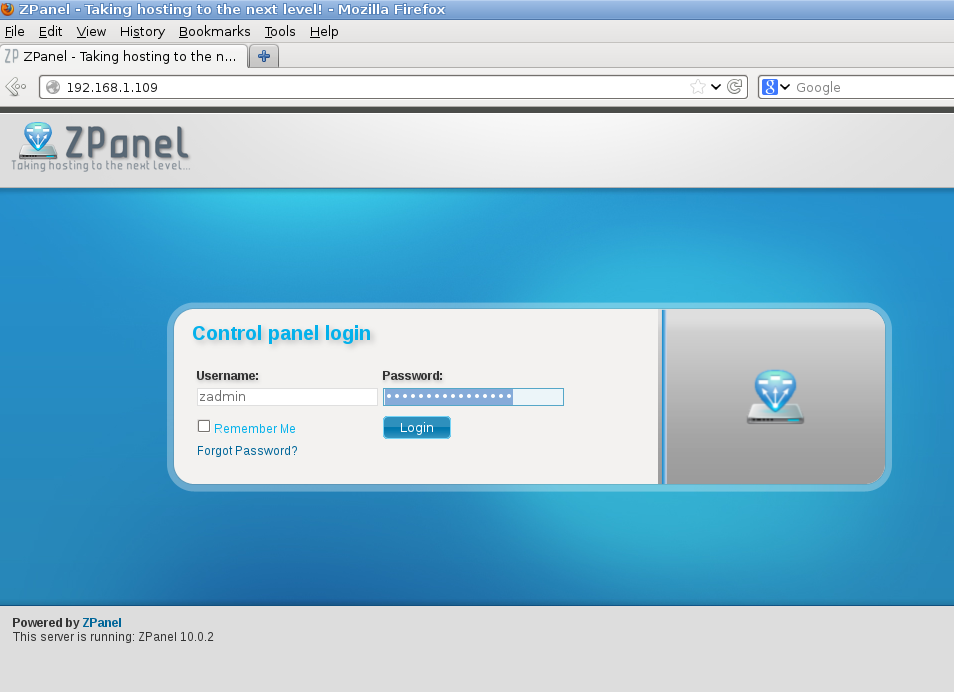
Screenshot-1

The  Server   will  restart automatically.
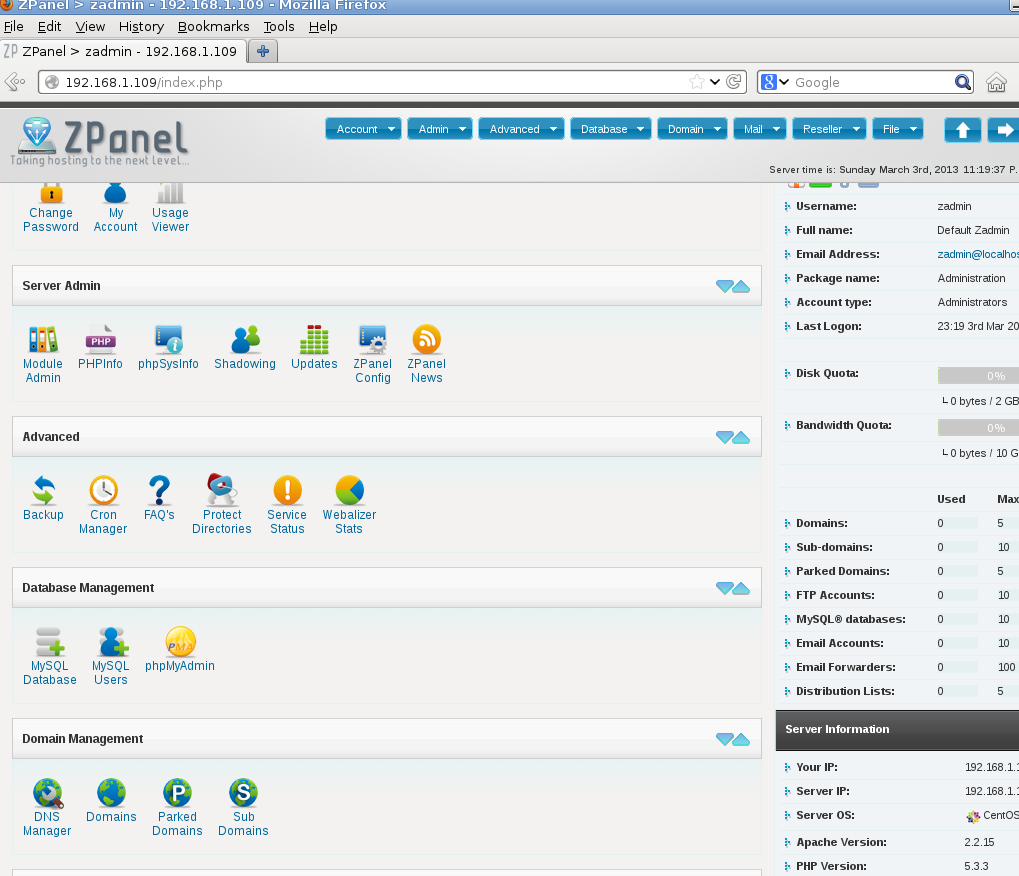
Please  connect to http://IP and  login with  zadmin user and  the  password  generated
Screenshot-2 Screenshot-3

and is done.
If you have any questions please post them in :http://ask.unixmen.com thanks.
For questions please refer to our Q/A forum at : http://ask.unixmen.com 

Difference between ext2, ext3 and ext4 filesystem in linux

It is always a question in our mind what are the basic difference between ext2, ext3 and ext4 filesystems.
So here is the answer for you,
ext2 :
- Introduced with kernel 1.0 in 1993
- Flexible can handle upto 4TB
- super block feature increase file system performance
- ext2 reserve 5% of disk space for root
- ext2 is popular on USB and other solid-state devices.
This is because it does not have a journaling function.
so it generally makes fewer reads and writes to the drive,
effectively extending the life of the device .
- NO journalalizm

ext3 :
- Provide all the feature of ext 2 + journaling and backward compatibility .
- can upgrade ext2 to ext3 without loss of data.
- journaling feature speed up the system to recover the state after power-failure
or improper mount unmount etc.
- Example: In ext2 in an improper unmount or in-between power-off etc.. so in time
of receiver it checks whole file system .
But in ext3 it keeps record of uncommitted file transactions and checks applied
on on them so system will come back up in faster and quicker .

ext4:
- Introduced with kernel 2.6.28
- Ext4 is a deeper improvement over Ext3
- support  larger filesystem, faster checking, nanosecond timestamps,
and verification of the journal through checksums.
- It is backward and forward compatible with versions 2 and 3, so we can
mount a ext2 or ext3 filesystem as ext4 .
- The main benefits that ext4 has over ext3 are:
- faster time-stamping
- faster file system checking
- journaling check-sums
- extents (basically automatic space allocation to avoid fragmentation)

What is Journalism in linux file system ?
A journaling is a file system,  that keeps track of the changes that will be made in
a journal (usually a circular log in a dedicated area of the file system) before committing them to
the main file system. In the event of a system crash or power failure, such file systems are quicker
to bring back online and less likely to become corrupted.

Hope, now you understand the difference between  ext2, ext3 and ext4 filesystem in linux.

Source:  http://www.rohitshrivastava.com/blog/2012/12/difference-between-ext2-ext3-and-ext4-filesystem-in-linux/

Cable Armour


The Problem

Many consumer connector standards (USB, HDMI, etc.) have found their way into professional camera technology and this brings the problem that they don't lock to the device they are attached to with them and that they are rather vulnerable to damage when sideway force is applied to the connector. Shooting in the field and having several cables hanging from the camera and not having a way to secure them in place is really cumbersome and has often lead to broken connectors or problems with devices being disconnected accidentally.

The Solution Concept: Cable Armour

The idea is to not require a special cable or a special connector but provide a protection system that can be used in addition to existing connectors.
  • works with almost any connector
  • locks from accidental cable unplugging
  • minimal integration effort necessary
  • protects cable connector from sideway forces
  • can be made from plastic for medium protection strength or aluminum for maximal protection strength

Patent pending?

Absolutely not! We release this as open hardware for anyone to use and build upon - be fair and do the same when you use this as foundation of your own solution
 

Dr. Jutta Kreyss, IT-Architektin bei der Landeshauptstadt München
Open Source Roundtable Bern, 28. Februar 2013
www.digitale-nachhaltigkeit.ch

Das IT-Veränderungsprojekt LiMux hat Ende 2012 sein Ziel erreicht, über 12.000 PC-Arbeitsplätze auf das auf Ubuntu basierende freie und offene Betriebssystem LiMux und die Bürokommunikationssuite OpenOffice.org (geplant ist LibreOffice) umzustellen. Der Vortrag soll den Aspekt „Nachhaltigkeit" näher beleuchten. Gemeint ist sowohl die nachhaltige Verankerung in der Verwaltung der Landeshauptstadt München, als auch die Nachhaltigkeit im Hinblick auf die Interaktion mit externen Instanzen, also den Bürgern, Unternehmen und anderen Kommunen und Behörden.

Dr. Jutta Kreyss ist seit 2011 IT-Architektin bei der Landeshauptstadt München. Sie betreut Kunden innerhalb der Verwaltung beim Einsatz von LiMux und anderer Open Source Software. Zuvor war Jutta Kreyss 14 Jahre bei IBM in verschiedenen Rollen tätig, zuletzt als Senior Certified IT-Architect bei IBM Deutschland Research & Development. Sie studiert Informatik an der Universität Hamburg und schloss 1994 ihre Dissertation an der Universität Bremen ab.

Tuesday, February 19, 2013

Mass Awakening - Exposed - True Heroes - Support These Open Source Companies - Group of Second Amendment - Supporting Gun Makers Now Refusing to Sell Arms to Law Enforcement in New York (And Other Gun-Restricting States) People Above Money - Nature Above Corporations - People Above Government - Money Is Slavey

the end of corruption, secret government, open source voluntary participation

Like, share, subscribe & comment! - http://www.RonPaul.com

Facebook: http://www.facebook.com/ronpauldotcom

Backup YouTube channel: http://www.youtube.com/subscription_c...

Email updates: http://www.RonPaul.com

01/21/2013

Ron Paul is America's leading voice for limited, constitutional government, low taxes, free markets, sound money, and a pro-America foreign policy.

To spread the message, visit and promote the following websites:

http://www.RonPaul.com (grassroots website)
http://www.house.gov/paul (Ron Paul in Congress)
http://www.RonPaulForums.com (discussion forum)

Disclaimer: This video is not-for-profit clip that is uploaded for the purpose of education, teaching, and research, which falls under fair use according to the Copyright Act of 1976 and tips the balance in favor of fair use; all intellectual content within the video remains property of its respective owners.


This story has been updated to add two additional gun makers and sellers to the list of those no longer patronizing law enforcement in states that do not support the Second Amendment.
Since New York State enacted its restrictive new gun laws, many manufacturers have sent that state (and others) a message: If local governments are going to severely restrict the ability of citizens to own guns, then these companies will not be selling to law enforcement in those areas.
Among the gun manufacturers sending that message:
Olympic Arms posted a press release on the company’s Facebook page earlier this week. Their intentions were quite clear.
FOR IMMEDIATE RELEASE:
Olympic Arms is a staunch believer in and defender of the Constitution of the United States, and with special attention paid to the Bill of Rights that succinctly enumerates the security of our Divinely given Rights. One of those Rights is that to Keep and Bear Arms.
Legislation recently passed in the State of New York outlaws the AR15 and many other firearms, and will make it illegal for the good and free citizens of New York to own a large selection of legal and safe firearms and magazines. We feel as though the passage of this legislation exceeds the authority granted to the government of New York by its citizens, and violates the Constitution of the United States, ignoring such SCOTUS rulings as District of Columbia v. Heller – 554, U.S. 570 of 2008, McDonald v. Chicago – 561 U.S. 3025 of 2010, and specifically the case of United States v. Miller – 307 U.S. 174 of 1939.
Due (to) the passing of this legislation, Olympic Arms would like to announce that the State of New York, any Law Enforcement Departments, Law Enforcement Officers, First Responders within the State of New York, or any New York State government entity or employee of such an entity – will no longer be served as customers.
EFI, LLC has a long-standing policy of not selling to law enforcement in states that restrict private gun ownership. TheBlaze interviewed EFI’s President Melinda Meador on the subject. Her statement was quite succinct:
“We refuse to recognize law enforcement exemptions on gun control. If a product that we manufacture is not legal for a private citizen to own in a jurisdiction, we will not sell that product to a law-enforcement agency in that jurisdiction.”
The company’s policy supports a broad market strategy for sales. Meador reminded us that “law enforcement sales don’t make up a significant portion of the market.”
The York Arms website is one that did not mince words on the company’s policy as it relates to gun sales for New York.
Based on the recent legislation in New York, we are prohibited from selling rifles and receivers to residents of New York. We have chosen to extend that prohibition to all governmental agencies associated with or located within New York. As a result we have halted sales of rifles, short barreled rifles, short barreled shotguns, machine guns, and silencers to New York governmental agencies.
For “civilian” customers residing in New York: 
At your choice, we will:
  • complete your order and ship to a dealer of your choice outside of NY
  • refund your payment in full
  • hold your items here for up to 6 months, at no charge – if you are in the process of leaving NY and taking residence in another state.
For LE/Govt customers in New York:
Your orders have been cancelled.
Texas-based La Rue Tactical also posted their new policy on Facebook on February 8th:
Effective today, in an effort to see that no legal mistakes are made by LaRue Tactical and/or its employees, we will apply all current State and Local Laws (as applied to civilians) to state and local law enforcement / government agencies. In other words, LaRue Tactical will limit all sales to what law-abiding citizens residing in their districts can purchase or possess.
Templar Custom of North Carolina is a North Carolina-based maker of precision rifles. CEO Bob Reynolds spoke with TheBlaze on Friday and reinforced the company’s position as posted on Facebook.
We will not sell arms to agents of the state of New York that hold themselves to be “more equal” than their citizens.
As long as the legislators of New York think they have the power to limit the rights of their citizens, in defiance of the Constitution, we at Templar will not sell them firearms to enforce their edicts.
Online retailer Cheaper Than Dirt stepped up with a supportive statement on their Facebook page on Friday the 15th.
Recently, companies such as LaRue Tactical and Olympic Arms have announced that they will no longer sell prohibited items to government agencies and personnel in states that deny the right to own those items to civilians. It has been and will continue to be Cheaper Than Dirt’s policy to not to sell prohibited items to government agencies and/or agents in states, counties, cities, and municipalities that have enacted restrictive gun control laws against their citizens. We support and encourage other companies that share in this policy.
In addition to these very public statements, gun-owner groups have been promoting these statements while also asking members and fans to contact three other manufacturers with significant sales to law enforcement in New York. One such group, Guns Save Lives, is actively asking people to write letters / emails to Sig Sauer, Smith & Wesson, and Glock and pressure them to stop selling to police in New York. Those three companies happen to be the trio of manufacturers recommended by the NYPD for use by their officers.
Calls and email inquires about any changes to their law enforcement sales policies have not been returned by Glock, Sig Sauer, and Smith & Wesson. If there is any additional information available, we will update this story.
(H/T: NC Gun Blog)


Related Posts Plugin for WordPress, Blogger...