Showing posts with label voluntary participation. Show all posts

Thursday, March 7, 2013

The GitHub Revolution: We’re All In Open Source Now :) We’re Witnessing The Birth Of A New Culture. It Is Less About The Project And More About The Individuals. The System Is Getting Decentralized :D

open source revolution, chnage, edit, people empowerment, decentralization of system

GitHub was intended to be an open software collaboration platform, but it’s become a platform for much, much more than code. It’s now being used by artists, builders, home owners, everyone in between, entire companies … and cities.

GitHub is doing to open source what the internet did to the publishing industry.
The city of Chicago recently announced, “anyone can now change the data when new bike paths are built, when roads are under construction, and new buildings are erected.” People are managing home-renovation projects on GitHub. One law firm also just announced that it’s posting legal documents for early-stage startup funding on GitHub.

Someone even published all of the laws in Germany on GitHub last year. (Perhaps not so surprisingly, he has about 17 open “pull” requests for changes.) And of course, GitHub is still used by programmers and developers flying AR Drones with Node.js or building websites with jQuery.

As people who were once just users become producers, they’re re-shaping the culture of open source. GitHub, I believe, is doing to open source what the internet did to the publishing industry: It’s creating a culture gap between the previous, big-project generation of open source and a newer, more amateurized generation of open source today.

The Revolution Will Not Be Centralized

When most people hear “open” source, they think democratic, distributed, egalitarian: everyone building things together for everyone else to use.

But that hasn’t actually been the case. Most open source software has been created and maintained by a privileged and protected class of people — professional developers — who interacted with other developers that were a lot like them (though were just different enough to have a good argument with).


Mikeal Rogers

Mikeal is the CTO of Getable and the curator of NodeConf. Roger’s long history in open source includes the Open Source Applications Foundation, Mozilla, CouchOne, and numerous projects across different communities.
Before GitHub, I spent a lot of my time thinking and talking about how to best manage open source projects because the coordination cost of an open source project was significant. So significant, in fact, that when a project did well and grew a big enough community, it made more sense for the project to grow rather than fracture into smaller projects. But the bigger and more complex a software project got, the harder it became to contribute. So an assortment of members — or “committers” — were tasked with managing and producing the project.

This often led to rifts between those producing and those consuming a project.

GitHub closed this rift by making open source much more decentralized. It became less about the project and more about the individuals.

The workflow for using GitHub is very personal. A person (I’m github.com/mikeal) has an account, and everything they publish exists one level below them. If someone else wants to fix something, they “fork” it, which puts a copy of it under them.

This workflow is very empowering: It encourages individuals to fix things and own those fixes just as much as they own the projects they start. It also gives all users an identity in the new open source culture; GitHub is actually the number-one identity provider for peer-based production over the internet in more than just code.
I’ve been contributing to open source projects for over 10 years, but what’s different now is that I’m not a “member” of these projects — I’m just a “user,” and contributing a little is a part of being a user. Little interactions between me and the project maintainers happen several times a week on all kinds of little projects I use.

And it happens even more often in the other direction: People I’ve never heard from send me little bits of code on all the little projects I’ve published.

As people who were once just users become producers, they’re re-shaping the culture of open source.

Decentralization as Democracy

The first versions of GitHub did one thing very well: They made it much easier to publish — than to not publish — your code. This was enough for many notable projects, including Ruby on Rails, to move to GitHub almost immediately.

But what happened next was even more interesting: People started publishing just about everything on GitHub…. Pushing code became almost as routine as tweeting. By reducing barriers to entry and making it easier to coordinate and contribute to open source, GitHub broadened the peer production to casual users.
Today a vast landscape of simple and understandable software is accessible to a creative class of people who did not have the depth of technical knowledge necessary to participate in the large open source projects of the past.

This blurring of relationships between producers, contributors, and consumers naturally values smaller and more easily understood projects — and has led to a long tail of contributions. In the entire month of September 2012, for example, half of all active GitHub users who pushed a “changeset” pushed fewer than five changesets, with 22 percent (about 44,000 people) pushing only a single changeset that month.
It became less about the project and more about the individuals.
This amateurization of open source software has some obvious benefits.

Making Things Easier to Use

One of the longtime problems with open source software has been fit and finish. Bad documentation, website design, and usability in general have been poor — especially when compared to many proprietary counterparts.

But now, with low barriers to contribution, less-technical users see these areas as easy places they can improve the very software they rely on. (This means little things like cryptic error messages get more humane and tiny one-line CSS changes make websites render correctly in ancient browsers and mobile phones.)
In the new open source, people want to use technology without having to become an expert in it. Ease of use is valued more than ever.

Preventing Over-Engineering

Engineers love a challenge and the more chances they have to solve it, the more clever their solutions can become. That was okay when the consumers of those solutions were highly technically minded people like them who rejoiced in clever ways to solve old problems.

But amateurs like solutions they can take for granted: Once a problem is solved, they will rarely go back or re-examine it. And because amateurs will only build on top of the most understandable solutions, it forces developers to create simple solutions that make hard problems easy to understand.

Supporting a Broader Ecosystem

Node.js, where I’m actively involved, defines enough simple patterns that people can write small libraries independently and publish at will. Everyone invested in the ecosystem can use that value without any coordination. This is the polar opposite of the big vertical stacks that come with lots of tools and features (such as integrated plugin systems like ember, Dojo, and YUI) that are required for success in proprietary environments (think Cocoa and writing for iOS).

But in open environments, like Node.js on GitHub, we see much smaller API footprints that can easily leverage the rest of the value in the ecosystem without coordination (for example callback APIs in jQuery or node’s standard callback pattern). The less coordination between developers and libraries the more we can create value.

- - -
GitHub has empowered a new generation of people to collaborate, create, produce. Many developers will lament the loss of former cultural norms — like the place of committers or the old fight about which license to use — but the future is already in the hands of a new generation that has moved on.
This isn’t just a tool: We’re witnessing the birth of a new culture.

Source: http://www.wired.com/opinion/2013/03/github/

Learn More Here: https://github.com

This talk introduces the Git Version Control System by looking at what Git is doing when you run the commands you need to do basic version control with it. We'll look at how to use Git to do the basics, while seeing how it differs from Subversion, what staging and committing actually looks like, how it stores it's data, how it branches and merges so nicely and how it talks to a server when pushing and fetching. Then we'll look at how to look at your history with log in interesting ways. This should help Git newbies get acquainted with the popular VCS and other Git users get a glimpse of what's happening under the hood.

** More educational videos on open source at http://marakana.com/techtv 


Monday, March 4, 2013

How Non Profit Organizaions Are Replacing Private Corporations And Make Your Local Communty Stronger, Happier: Saving Time + Money

time to act, post capitalism, end of ue, end of nato, end of bankers monopoly


*My part starts at 8:43

I was proud to be part of this Energy Saving Tips Video Project for the Non-Profit company that I am currently part of, Learn away ^_^

----------------------------------------
­----------------------------------------­--------------------------------------
Non-Profit super hero by day, Music Producer/DJ ninja by night...
Born and raised in Los Angeles,California, Disneyland was his home away from home, moved to Oregon at the age of 17, and has remained there ever since. Started working for local radio stations at the age of 19, and DJ'ing for a hobby. A few years down the road, he started producing his own electro house music, expressing his feelings thru SoUnD WaVeS.

http://about.me/michaelmartinez

Currently he also works full time for a large local non-profit organization, which offers to serve and speak out for economically disadvantaged people, with the mission to break the cycle of poverty, removing barriers that prevent individuals from achieving economic self-sufficiency, needless to say its a very rewarding job.


Tuesday, February 26, 2013

Educate Free Online - 11 Biggest Open Source Success Stories That Are Changing The World As We Know It - Amazing Times To Live :)

capitalism system was based on scarcity, money system was based on scaricity, open source currency
According to Fortune, Open Source is slowly gaining acceptance in the corporate world. More and more corporates are beginning to see the merits of Open Source and have started embracing it. But all these changes didn't happened overnight. It was rather a painful journey. 'Sharing' was never a good thing for Corporates until recently. These changes were largely brought about by a string of Open Source success stories that happened over the years.

GNU/Linux

GNU/Linux

GNU/Linux is probably the biggest thing ever happened with Open Source. Richard Stallman, founder of Open Source Free Software movement, spearheaded a project to build a "complete Unix-compatible software system" based entirely on free software(free as in freedom).

Project was called GNU(GNU is Not Unix). During the same time Linus Torvalds built a Kernel(which is otherwise known as the heart of an opearting system) and made it Open Source. He named it Linux. The Linux kernel and GNU tools(libraries, compilers, text editors etc) combined to become GNU/Linux operating system(popularly known as 'Linux').

RedHat

RedHat
RedHat is probably the first ever corporate establishment to make it big with Open Source. According to wikipedia, RedHat cloaked revenues of US$ 748.23 million in 2010. And if estimates has to be believed, RedHat is poised to become a billion dollar company in another year or so. [4 Must Watch RedHat Commercials]

Debian

Debian is one of those open source projects that truly heralded a new era for Linux based operating systems out there. Many of the most popular Linux distributions out there like Ubuntu are based on Debian GNU/Linux.

Debian is developed by over one thousand volunteers and is supported by donations through several non-profit organizations from around the world. Support Debian.

Ubuntu

Ubuntu Logo

Ubuntu needs no introduction especially if you are a daily reader of our blog. Ubuntu is the most popular Linux distribution out there and also probably the first ever Linux distro to overshoot popularity of Linux itself.

Ubuntu is basically a derivative of popular linux distro called Debian. Ubuntu is sponsored by the UK-based company Canonical Ltd., owned by South African entrepreneur Mark Shuttleworth. According to some rough estimates by Canonical, there are around 12 million Ubuntu users out there. Ubuntu is growing and growing fast.

WordPress
Wordpress Logo

WordPress is an open source CMS(Content Management System), often used as a blog publishing application powered by PHP and MySQL. The core software is built in the true spirit of Open Source by hundreds of community volunteers. WordPress is used as a platform by over 300 of the 10,000 biggest websites.

WordPress is the most popular blog software in use today. The 2009 Open Source CMS Market Share Report reached the conclusion that WordPress enjoys the greatest brand strength of any open source content management systems.

Drupal
Drupal Logo

Like WordPress, Drupal is another popular free and Open Source Content Management System(CMS). From May 2007 to April 2008, Drupal was downloaded from the Drupal.org website more than 1.4 million times, an increase of approximately 125% from the previous year. It is estimated that, as of July 2010, about 7.2 million websites use Drupal as its CMS.

MySql
MySql

MySql is probably the most popular Open Source database management application in the world. MySQL began as a low-end alternative to more powerful proprietary databases and gradually evolved to support higher-scale needs as well. To give you an idea what "higher scale" means, MySql is the tool that powers such large scale websites like Wikipedia, Google and Facebook.

Apache
Apache

Apache is basically a webserver software which can be called as one among the most important build block of Internet as we know it today. Since April 1996 Apache has been the most popular web server software in use. As of February 2010 Apache served over 54.46% of all websites and over 66% of the million busiest.

Firefox
Firefox
Firefox is the most "visible" Open Source success story. Firefox's big fight with Microsoft's Internet Explorer is widely discussed in mainstream media. IE is still the most popular web browser in the world, primarily because Windows holds a monopoly in Operating Systems market share.

Firefox 4.0 is the next major Firefox version waiting in the wings for its final descent. It showcases features such as Tab Candy, which is probably going to kick start another round of innovation in the web browser market. [4 Beautiful Firefox Ads You Would Love to Watch]

OpenOffice

OpenOffice

OpenOffice is the leading open-source office software suite for word processing, graphics, spreadsheets, presentations, databases etc. OpenOffice moved from a "free-but-not-so-useful" application to a viable alternative to Microsoft Office quite fast.

The OpenOffice.org web site reported more than 98 million downloads as of September 2007. OpenOffice.org 3.x reached one hundred million downloads, just over a year since its release.

Google Chrome

Google Chrome

Google is probably the first ever BIG corporate to understand the true potential of Open Source. Google Chrome was the first in line among many applications released by Google as Open Source. Google Chrome is now the fastest growing web browser out there and is nearing a 10% market share. [4 Awesomely Creative Google Chrome Ads]

Android
Android Wallpaper


Android is the newest kid in the block. Another Open Source product from Google, Android OS for mobile devices is eating into the market share of incumbents like iPhone's iOS and Nokia's Symbian OS.

According to Gartner, by 2012, Android would become the world's second most popular smartphone platform, behind Nokia's Symbian OS. A market dominated by Linux? Can you believe it!! It's already happening. [15 Beautiful Android Wallpapers For Desktop]

PS: I really wanted to include a lot of my favorite free software applications like GIMP, Blender etc. But the list is basically a collection of Open Source applications that had the biggest impact. And I wanted to keep it nimble. Hence the list.

PS: The list now contains 12 projects instead of 11, since Debian was not included in the original list. As some of our readers have pointed out, there is no point in listing "open source success stories" excluding Debian project.
[Image Source: 1, 2, 3]
mp3:http://bit.ly/siAsCj Two legendary comedians offer their perspectives on life, through song.

Original videos:
Bill Hicks: http://www.youtube.com/watch?v=iMUiwT...
George Carlin: http://www.youtube.com/watch?v=EjmtSk...
Baraka: http://www.youtube.com/watch?v=XO1nSV...
Koyaanisqatsi: http://www.youtube.com/watch?v=PirH8P...

Instrumental: http://soundcloud.com/melodysheep/the...

Subscribe for more! ~melodysheep

Lyrics:

Is this real?
Or is this just a ride?

The world is like a ride
You think it's real - it's just a ride
And we can change it any time we want
It's only a choice - between fear and love

The ride goes up and down and round and round
It has thrills and chills and it's very brightly colored
Up and down and round and round
And it's very loud

Don't worry, don't be afraid
It's just a ride
And we can change it any time we want
It's only a choice between fear and love

Why are we here?
I think we're part of a bigger wisdom
That we won't ever understand
A higher order - call it what you want -
Know what I call it?

Tuesday, February 19, 2013

New Soviet Union Exposed - Collectivism Is Not Working - BREAKING: Massive Riots In Bulgaria Against The Government, Electricity And Bank Mafia, And Protesters Demand For Bulgaria To Leave The Fascist EU - Invest In Free Energy And Urban Gardening

eu is the new soviet union, eu is fascism, global governance is a joke

Massive riots have been going in Bulgaria in the last couple of days. The biggest ones that the country has seen in the last 20 years. More than 300 thousand people went out and protested against the ongoing stealing by the bankers and the electricity companies /CEZ, EON and EVN/, piling pressure on the government after a week of persistent demonstrations.

Tens of thousands join electricity protests across Bulgaria
http://www.reuters.com/article/2013/02/17/us-bulgaria-protests-electricity-idUSBRE91G0C520130217
Bulgaria sacks finance minister amid protests
http://news.yahoo.com/bulgaria-sacks-finance-minister-amid-protests-175513831–business.html
* Protesters demand for Bulgaria to leave the EU *
http://www.focus-fen.net/?id=n299814
A side of the demand to nationalize the power companies, people also want the gold mine which recently has been found to be nationalized also. There are deposits of 18 000 tones of gold ore with concentration of 445 gr per ton. As estimated in USD there is gold with value of ~793 BILLION USD!
Right now the gold mine is owned by Dundee Precious Metals which is a Canadian company. From all the gold that is excavated only 1 PERCENT remains for Bulgaria!

time to wake up, personal liberties, people above capitalism, people above money

http://www.dundeeprecious.com/operations/development-projects/krumovgrad/default.aspx

There have been some clashes with the riot police, but in the city of Varna something unprecedented happened. The chief of the city police said that they are on the side of the protesting people, but there still must be no destruction and looting. To show their support of the people, the riot police putted their shield and helmets on the ground! From the other side people gave them flowers.


IMAGE http://www.razkritia.com/wp-content/uploads/2013/02/varna-protest10.jpg
IMAGE http://images.btv.bg/usernews/2013/02/17/493842/620×348.jpg
IMAGE http://images.btv.bg/usernews/2013/02/17/493814/620×413.JPG
Sunday saw the biggest demonstrations in eight days of protests. More than 2,000 people blocked the highway to Greece near the southern town of Dupnitsa and in the capital Sofia protesters blocked traffic on the famous Eagles’ Bridge
IMAGE http://images.btv.bg/usernews/2013/02/17/493805/620×465.jpg
- – - – - – - -
On 24.02.2013 there is going to be a nationwide protest and it is expected more than 800 000 people to go out on the streets. People gave the government a 7 days period to get rid of the electricity companies and to nationalize the infrastructure.
http://news.yahoo.com/bulgarians-protest-foreign-power-companies-153248204–finance.html?utm_source=dlvr.it&utm_medium=feed

Source: http://investmentwatchblog.com/breaking-massive-riots-in-bulgaria-against-the-government-electricity-and-bank-mafia/

Втори протест срещу монополите в София, заснет от въздуха с квадракоптер. Звукът е записан отделно на земята.
Kлип от предходния протест: http://www.youtube.com/watch?v=vJnZv_...

http://www.skymedia-bg.com/


Протест срещу ЧЕЗ - 17 Февруари 2013 г. Блокиране на e-79 в Благоевград
Видео: Електронна медия Благоевград ЕУ http://blagoevgrad.eu

Protest against CEZ - February 17, 2013 e-Block 79 in Blagoevgrad
Video: Electronic Media Blagoevgrad EU http://blagoevgrad.eu
It was and the destruction of the blockade by police...


Remember That A Revolution Of The Consciousness Will Bring A Better World Not Violence..

Demand: Free Energy For All, Seize The Central Bank And Enact A New Local Golden Base Currency, Urban Organic Agriculture, Free Education, Free Open Source Internet, Taxing the Private Corporations, Jail the Bankers, Right To Vote Every Law, Right To Vote Any Law If Petition Reaches 50000 Signatures And Other Things :)

Saturday, February 16, 2013

Support Open Source Revolution - Everyone In The World Is Coding.. How Well? Hmm..Check Your Thoughts.. Let’s Start Now! Be Happy :)

community involvement, control and openness, time to become part of open source movement

LiveCode lets you create an app for your smartphone, tablet, desktop computer or server, whether you are a programmer or not. We are excited to bring you this Kickstarter project to create a brand new edition of our award-winning software creation platform.

LiveCode has been available as a proprietary platform for over a decade. Now with your support we can make it open and available to everyone. With your help, we will re-engineer the platform to make it suitable for open source development with a wide variety of contributors.

Support our campaign and help to change coding forever.

http://www.kickstarter.com/projects/1...
  • Launched: Jan 29, 2013
  • Funding ends: Feb 28, 2013
Have you ever had an idea for an app but don’t know how to code?
Have you ever wanted to learn how to code but found it too difficult?
Have you ever been frustrated by how long it takes to write an app?
Are you frustrated with the current state of computer science education in high school?
Do you want to help establish coding as a new form of literacy?
Are you interested in a better way to write software for your company?

If you answered YES to any of these questions, then we need your help.

In 1987 Apple created a program called HyperCard. If you haven’t heard of it, all you need to know is that tens of millions of end user programmers used it. It was the easiest and most popular end user programming environment ever created, before or since.

LiveCode is like a next generation version of HyperCard. It is used to create #1 one app store apps, real-time flight booking systems and control satellites. It is used to create simple one off apps and utilities to solve day-to-day problems.

There are some things it can’t do – yet. This project is to create a next-generation LiveCode.

Our vision is that this new next-generation LiveCode will be free and open source.

It will run on every popular platform and device.

It will let you write programs in English.

And by being open, its English language programming will be extensible to any computing problem out there. That's a world first.

If you couldn’t code before, LiveCode is the answer. If you’ve used the existing version of LiveCode before and it didn’t do everything you needed, this next-generation version has you covered.

What is LiveCode? Our story.

we are all connected, we are a happy family, computer and spirit, eternal life

Computer Science Students Love LiveCode

Almost a quarter of secondary schools in Scotland are now teaching with LiveCode.
Every school that has used LiveCode for more than a year has seen a doubling of uptake in advanced computer science classes!

By supporting this project, you’ll be helping create a version of the platform even more suitable for teaching.
It will be free for schools and universities worldwide.

We believe that computational thinking and programming is a key form of digital literacy and that enabling a new generation to write interactive software is critically important in today's economy.

Students use LiveCode to create games and apps for their own smartphones and tablets. Although the LiveCode language is easy to use, it is a sophisticated and complete programming language suitable for teaching all aspects of computational thinking needed for this age group, even including advanced concepts for older students (e.g. arrays, parameter passing by reference).

The open source edition of LiveCode will be free and available to schools globally. Read more about LiveCode in Education.

What is your money going toward?

We need to raise £350,000 to fund an experienced team to do this right.

We will re-engineer the whole platform so it is easy for the community to contribute to the code base. Did you know that Linux only took off after a version of it was created that was modularized with a kernel? We’ll be doing the same to LiveCode. If you’re technical, you can read all about this here.

We will introduce a new technology called “Open Language”. With Open Language, the more technical members of our community can create English-like words and phrases to enable everyone to write programs that use any aspect of a computer or device. If you’re technical, you can read all about that here.

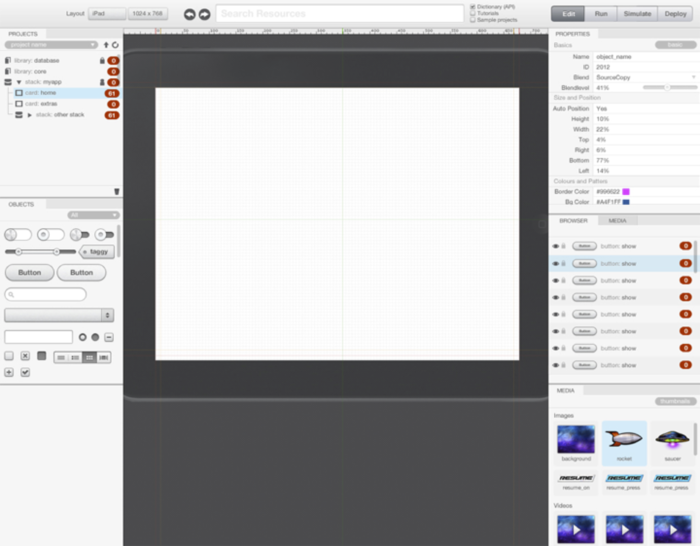
We will introduce a new visual editor designed around today’s usability standards. The editor will be open. The more technical members of our community can create simplified versions of the editor for tablets or primary schools.

Here is a screenshot of the prototype:


we are friendly, community free software, linux revolution, ubuntu market share
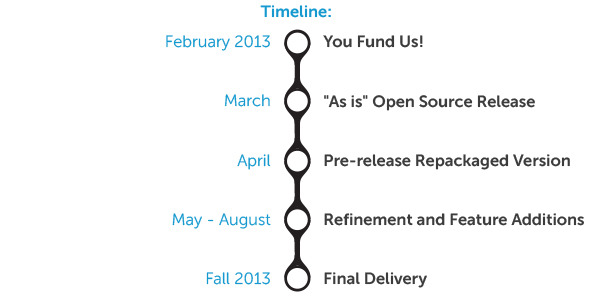
When Will it Be Completed?
Within a month of the campaign closing we will launch the Community Edition with the source code. That version will have the source code as it is today. This will provide everyone who has made a pledge access to the platform.

Over the following few months we will be hard at work on the main goal of creating the next generation of the platform. We will restructure the code into modules that plug into a new kernel and deliver this version for testing over the summer. Once that is complete the community will be able to contribute to the source code easily.


alpha, beta, release candidate, final release, learn from nature, selfownership
Technical Summary of Kickstarter Deliverables
We are going to use the Kickstarter funding to deliver the next generation of the entire LiveCode language and visual development environment. To do this we need to do some packaging and updating, including:
  • Packing the source code into community-friendly modules
  • Optimize the execution engine and some older components
  • Add a clean architecture to allow new language plugins to be developed
  • Create a new, beautiful graphical front-end for building your apps
The scope of these tasks is considerable. We will be reorganizing some half a million lines of C++ code, running on six platforms - Windows, Mac, Linux, iOS, Android and Server, into straightforward modules that plug into the new kernel. We will be porting our English-like syntax into a new uniform virtual machine layer and adding a way to let the community add its own syntax. Another team will be working on re-designing the visual editor in parallel to make the platform even easier to get started with and use!

While we will be making the code base available in its current form immediately, these important changes will take the platform to the next level, and make it much easier for the open source community to make contributions. At the end of this we will have a beautiful, consistent and openplatform.

Stretch Goals

We have designed the project to be flexible and there is so much more we can add to the new Open Source platform.

We have some truly amazing stretch goals - features for students, for gamers, for commercial companies and more. Supporting our stretch goals will let us deliver the future to you much faster. Example stretch goals include a brand new multimedia layer, new sprite capabilities and support for additional platforms!

We have goals covering virtually every enhancement request our customers have ever made, so please stay tuned.

Who You Will Be Working With


Rewards

Every pledge you make is so important to the success of this exciting project and we have developed fantastic rewards to thank you for your support.

Everyone who contributes more than £12 ($20) will get a complete set of LiveCode Training Academies where you can learn everything you need to know to create your own app or game.

The pricing in euros and US dollars is an estimate and your actual conversion rate may vary slightly.
Please Make a Pledge. Thanks very much for your support.

Risks and challenges Learn about accountability on Kickstarter

There is no doubt that this is a massive project. Like every software engineering project of this scope, careful planning is needed. Our experienced team of LiveCode experts have spent months planning out the delivery of this project. Everyone is looking forward to the challenge.

With your support we will deliver the next generation, open source LiveCode and bring coding to everyone.
Thank you so much for your support.

Learn From Nature - Nature And The Universe Is Open Source - Time To Abolish All Patents - Everything Will Be Free And Open For All - Closed Source Corporations And Governments Will Seize To Exist

right to digital information, mozilla, linux revolution, time to be free, waking up times

"Patents are here to stay." This is the sort of statement that makes me uneasy. I guess in the 17th century the common wisdom was "slavery is here to stay." In the 18th century giving voting rights to women seemed absurd and foreseeing open borders between France and German was crazy talk in 1945. At a certain point, fortunately, those things changed for the better. Is it time to change the common wisdom on patents as well? Is the time ripe—will it ever be?—to utter the frightening word abolition? I do not have the privilege to know the answer, but I regard the question as a legitimate one. According to some patent experts, however, questioning the very existence of patents seems blasphemous.

Why?
Patents have a strong appeal to many. Those who have a large patent portfolio, for instance. Lawyers and patent attorneys do not seem particularly eager to see their careers end either. The same can be said for patent offices. The list is rather long. I must confess, I myself make part of my living consulting on patent-related transactions, so I have a stake weighing against abolition. All the same, it would be unfair to just say it is only a conflict of interest. It is also, perhaps chiefly, a cultural bias. We know what we have, but we don't really know what we don't have. The system has worked well for so many years, why should it be abolished? Can't it be just reformed? And if abolished, to be replaced with what? Horror vacui! Again, common wisdom.


Don't get me wrong, I am not saying that all patents should be abolished tomorrow unconditionally. Of course we should apply an old saying: "Primum non nocere." (First, don't do damage). Keep a conservative approach, prefer freedom of enterprise over restriction and exploitation of others' work. Instead, incidentally, there is a strong and unbelievable push toward ever increasing patent protection, monopolies, new forms of "intellectual property", even without any trace of evidence, or even an attempt to gather any, that such changes are beneficial. Europe and database rights should be an example of this wrongful attitude. But having said that, I have no one-size-fits-all solution to the issue at hand, although all evidence points in one direction: abolition.

But patent abolition does not appear in any legislative agenda, with some exceptions, like New Zealand (although prohibition to patent software is apparently being watered down to match the current situation in Europe). If you dare—as I dared—to put it on the discussion table, asking, "Why do we have patents, wouldn't we be better off without?", then you are labeled as an Utopian at best, implying you are a fool and are attacking property as well as the free market. Pas du tout!

Patents are a relatively recent creation conceived as a means to a goal. I therefore consider it a legitimate proposition to ask if the goal (spurring innovation by providing incentives, via a monopolistic prize, to research and development) is best served with patents and whether the cost is too high.

Some say this is just wishful thinking. Even if they concede that questioning patents is a legitimate activity, it is just a philosophical one to them. A very competent and brilliant Free Software colleague, in order to reject the evocation of a future abolition of patents, and in particular of the so-called software patents, used a very evocative Scottish proverb: "If wishes were horses, beggars would ride." Meaning, of course, it is not going to happen.


Are we sure?
Only three or four years ago, it was commonly thought that the patent system in technology was capable of self-regulation. Some characterized the process (as did I, but with different conclusions) as Mutually Assured Destruction (MAD), a situation where balance is reached similar to the balance of forces during the Cold War. But MAD doesn't work for Non-Practicing Entities (NPEs), or as they are often referred, for patent trolls. Good, they say, get rid of trolls and the system is fixed. Not quite so, sorry.

MAD works only when two opposing forces are equally and mutually threatened, which does not apply in many cases, beside the patent trolls example. What is more troublesome is even when in theory there are two big players with dozens of patents, MAD has not worked well. The last two years have shown that, at least in the smartphone industry, MAD did not provide sufficient incentives to stay out of the courthouses. Indeed everybody has sued everybody else almost everywhere.

But this is just the tip of the iceberg, we can't count how many businesses are disrupted by the threat of impending patent litigations, in a system where the mere chance of litigating a patent lawsuit is frequently not an option for the long tail where innovation mostly occurs. Patents are there more to preserve the existing technology than to spur new technology to come around. This is by design, and has always been so, but now technology moves at a faster pace and the contradiction is more evident.

Everybody sees that the system is not working, it creates problems, it destroys value, it provides incentives not to innovate, but to litigate. Most of the time such litigation is engaged by someone who would otherwise be disrupted by more efficient competition. Economic studies are stacking up showing how the economy of patents is completely astray, especially in the Information Technology field. The evidence that at least some kind of radical reformation is required is so abundant that even hitherto unsuspected sources, for instance free market, School of Chicago thinkers like Gary Becker and Richard Posner, are speaking up, calling for excluding certain fields of technology from patenting. These include fields where investment is slim and rewards are huge, making software patents the best example where this should occur. The curtain of silence is being lifted. Some of the patents issued, such as those on software and on graphical user interfaces, are receiving a lot of attention reaching the front pages of the news. Even the U.S. Patent and Trademarks Office seems to be taking a U-turn on the rubber stamping some patents of a kind that formerly had a very easy way forward.


Finally, one cannot underestimate the fact that Free Software (or open source) is really having a huge impact in the new paradigm shifts, including the rise of social networks and cloud computing. Patents and Free Software are antonyms. Recently Richard Stallman provided an easy operative way to overcome the problem of defining what a software patent is, which is all in all consistent with my own litmus test: it's a software patent when you infringe it by distributing software. It may be a rough, blunt rule, but it provides the bulk of what we need to surgically remove software patents if we want to preserve most of the systemcar. Free Software provides a clear case for abolition and its main proponent provides a clear rule to deliver it and preserve the system. But Free Software is just one aspect, albeit a major driver, to the shift that is occurring now.

We are experiencing the dawn of a new era in technology (especially in the software), massively moving from scarcity to abundance of digital goods, akin to the big discontinuities that happened in history, of the same order of magnitude as moving from hunting and collecting to farming, or from non-industrialized, hand crafted, to industrialized, automated production of goods.

Newcomers, disruptors, have this in common: they want to get rid of the existing system, by removing the tools that preserve the status quo, for which the poster child is the patent system. Unsurprisingly, today's disruptors are en masse speaking against software patents. This ranges from Amazon—certainly not shy on patenting, but having in Jeff Bezos someone who calls at least for huge and swift reform—to Google, Twitter, Facebook, Rackspace, Red Hat, and many others, who hold a stance against software patents with various degrees of radicalism, putting it in black ink.

Digital rights activists, scholars, public opinion and (perhaps the majority of) economic interests are getting closer, inching towards abolitionist positions. It is happening now. How fast is hard to say, but the direction is—at least to me—clear.

Call me a fool, but I believe we are about to see some beggars riding a lot of odd horses in a short while.

Source: http://opensource.com/law/13/1/abolish-patents-too-soon-late#comment-11629

Opensource vs Closed-source (most Commercial Software). How to explain to kids the the *fundamental* difference between Opensource and Commercial Software? This is hard but with a bit of a caricature we are doing it here. So share & pool your resources and you get further (open source) than doing it alone (commercial software).


4 Ways The New Soviet Union EU Is Destroying Free Software:

1. passing laws for software patents, such as the Unitary Patent
2. claiming software patents are compatible with FLOSS
3. passing laws for DRM such as the EUCD
4. Passing laws containing undefined & anti-FLOSS terms such as FRAND

The open-source world has learned to deal with a flood of new, oftentimes divergent, ideas using hosting services like GitHub -- so why can't governments? In this rousing talk Clay Shirky shows how democracies can take a lesson from the Internet, to be not just transparent but also to draw on the knowledge of all their citizens.

TEDTalks is a daily video podcast of the best talks and performances from the TED Conference, where the world's leading thinkers and doers give the talk of their lives in 18 minutes (or less). Look for talks on Technology, Entertainment and Design -- plus science, business, global issues, the arts and much more.
Find closed captions and translated subtitles in many languages at http://www.ted.com/translate

Follow TED news on Twitter: http://www.twitter.com/tednews
Like TED on Facebook: https://www.facebook.com/TED

Subscribe to our channel: http://www.youtube.com/user/TEDtalksD...

Tuesday, February 12, 2013

Tyranny Turning Point - Full Film [HD720p] Time to Unslave Humanity - Releasing The Universal Open Source Code

slavery collapse, free world, free humans, free everything, compassion, female thinking

~Unslave Humanity Tactical Media: http://whynotnews.eu/?p=2078 ~credits video: http://youtube.com/weavingspider

Press For Truth Presents: The Turning Point

You have been selected to attend the 60th Bilderberg conference in Chantilly, Virginia from May 31 - June 3, 2012. This conference brings together leaders of business, economics, media, finance, politics and military in a forum which will allow for open and off the record discussions of current events and global issues.

I must stress that this meeting is SECRET and by invitation only. We operate under Chatham House Rules, meaning you are not permitted to discuss anything that is said during the conference to members of the media or otherwise.

Please keep all of your arrangements confidential, including all of the information included herein. In recent years we have lost much of our control over the dissemination of information due to the rise of independent media sources and internet-based journalists. We intend to correct this problem and plan to discuss it at this year's conference.

The Turning Point - A Press For Truth Production

Produced and written by: Steven Davies, Bryan Law and Dan Dicks
Edited by Steven Davies and Bryan Law
Music by Dan Dicks

You can also support independent media by joining Press For Truth TV: http://pressfortruth.tv/register/

We rely on you the viewer to help us continue to do this work. With your help we can continue to make videos and documentary films for youtube in an effort to raise awareness all over the world.

As a Press For Truth TV subscriber you'll have full access to the site's features and content including Daily Video Blogs on current news from the PFT perspective and High Quality Downloads of all Press For Truth Films, Music and Special Reports! Subscribe to Press For Truth TV: http://pressfortruth.tv/register/

For more information visit:
http://pressfortruth.tv

Please support Press For Truth and help us continue to do this work by donating or becoming a sponsor at http://pressfortruth.ca:
http://www.pressfortruth.ca/donatebec...

http://www.facebook.com/PressForTruth
http://www.youtube.com/weavingspider
https://twitter.com/PressForTruth
http://twitter.com/#!/DanDicksPFT

http://pressfortruth.ca

Editor's Note: The photo at 20:20 is of Buzz Hargrove former president of CAW and not that of Ronald Lloyd from Credit Suisse Canada. See here for correct info: http://ca.linkedin.com/pub/ron-lloyd/...

~original more info: "Creative Commons Attribution license (reuse allowed)"

~Unslave Humanity Tactical Media: http://whynotnews.eu/?p=2078

This video is [FAIR USE] under © COPYRIGHT LAW it is: 1 noncommercial 2 trans-formative in nature 3 not competitive with the original work 4 not effecting its market negatively FAIR USE NOTICE: This video contains copyrighted material the use of which has not always been specifically authorized by the copyright owner. We are making such material available in our efforts to advance understanding issues, etc. We believe this constitutes a 'fair use' of any such copyrighted material as provided for in section 107 of the US Copyright Law. In accordance with Title 17 U.S.C. 107, the material on this site is distributed without profit to those who have expressed a prior interest in receiving the included information for research and educational purposes.

~infopowerment truthers network~
-new kind of unity against tyranny-

http://infopowerment.whynotnews.eu
http://facebook.com/infopowerment

1 http://youtube.com/2012WhyNotNews
2 http://youtube.com/911TruthAnniversary
3 http://youtube.com/Agony4Truth
4 http://youtube.com/AlexJonesFeeds
5 http://youtube.com/AntiNWOMafiaTools
6 http://youtube.com/Celebs4Truth
7 http://youtube.com/ChemTruthers
8 http://youtube.com/CropCircleMatrix
9 http://youtube.com/DavidIckeNews
10 http://youtube.com/ExoLogan
11 http://youtube.com/EX0MATRlXTV
12 http://youtube.com/ExomatrixTV2012
13 http://youtube.com/eXoPolitics2012
14 http://youtube.com/ExoTubes
15 http://youtube.com/ExoVlogo
16 http://youtube.com/ExoWake
17 http://youtube.com/infopowerment
18 http://youtube.com/JohnKuhles
19 http://youtube.com/Musicians4Truth
20 http://youtube.com/NigelFarageFans
21 http://youtube.com/NwoFoodWars
22 http://youtube.com/NwoSatire
23 http://youtube.com/OccupyNWO
24 http://youtube.com/Poems4Truth
25 http://youtube.com/Quest4Wisdom
26 http://youtube.com/Rappers4Truth
27 http://youtube.com/RonPaulRevolt2012
28 http://youtube.com/SolutionRevolutionS
29 http://youtube.com/SuppressedArcheology
30 http://youtube.com/SuppressedCures
31 http://youtube.com/TransDehumanism
32 http://youtube.com/TrutherCouncelor
33 http://youtube.com/UfoDisclosure2012
34 http://youtube.com/Women4Truth

~responsible people think4themselves
http://infopowerment.whynotnews.eu

Latest News Updates About You Privacy And Personal Life - Governments Must Respect Natural God Given Laws - Right To Personal Happiness

ego is teaching you, private government, open source collaboration, new happy life

Ediscovery, Privacy, Data Protection and Social Media Weekly Updates

RT @agonarch: Nice! @StatewatchEU compares existing ’95 rules with #EUdataP http://www.statewatch.org/news/2013/jan/Table%20eu-dp-reg-chart-1995-comparison.pdf …
Myth busting: what EU Commission proposals on #dataprotection do & don’t mean http://ec.europa.eu/justice/newsroom/data-protection/news/121207_en.htm … #eudatap#datenschutz #privacy #cloud
Related Posts Plugin for WordPress, Blogger...