January 25th, 2013 by Monique Altheim
January 18th, 2013 by Monique Altheim
- Netflix Case Illustrates Potential Social Media Pitfalls Facing Public Companies http://ow.ly/2ul7b4
- Seventh Circuit tosses right of publicity case against Joan Rivershttp://ow.ly/2ul9az
- Ediscovery and DataProtection Daily is out!http://paper.li/EUdiscovery/1312257398 … ▸ Top stories today via
@DiplomaticallyX@EinsteinsAttic
- HHS Issues Final Omnibus Rule Modifying HIPAA Privacy, Security, Enforcement and Breach Notification Rules
- HHS Issues Long-Awaited Final HITECH Regulations – By Anna Kraus and Rachel Grunberger The U.S. Department of Health…http://ow.ly/2uktt8
- HHS Issues Final HITECH Regulations – The Department of Health and Human Services (HHS) just released the highly ant…http://ow.ly/2ukhK3
- CNIL Issues Opinion on Response to Albrecht’s Report to the LIBE Committee http://ow.ly/2ukc0Z
- Western District of Washington Amends Local Rules – On December 1, 2012, newly amended rules went into effect in the… http://ow.ly/2ukc10
- Commerce Department to Host Data Privacy Seminar – On February 8, 2013, the U.S. Department of Commerce’s Internatio…http://ow.ly/2uk22Z
- Genesco may sue credit card companies over fines for 2010 data breach http://ow.ly/2ujSwZ
- Ediscovery and DataProtection Daily is out!http://paper.li/EUdiscovery/1312257398 … ▸ Top stories today via
@elettorale@RichardMoorhead @danpgabriel
- Facebook’s Bold, Compelling and Scary Engine of Discovery: The Inside Story of Graph Search via
@Wired http://www.wired.com/business/2013/01/the-inside-story-of-graph-search-facebooks-weapon-to-challenge-google/ …
- EU ministers to consider ‘two-strikes’ rule for data breacheshttp://ow.ly/2uiZHL
- Software Developer Who Cleverly Outsourced His Job To China Betrayed By His Digital Footprint http://ow.ly/2uiRQW
- FTC Settlement Targets Mobile App Background Checks – On January 10, 2013, the FTC announced a groundbreaking settle…http://ow.ly/2uiHX5
- EU Data Privacy Rules to Extend to All Software and Hardware Manufacturers — Regardless of Whether They Process Per…http://ow.ly/2uitXE
- Zaxby’s customers need more information – When Zaxby’s Franchising Inc. announced that it was investigating th…http://ow.ly/2uitXF
- More details emerge on DoDDS-EU breach – A previously reported breach that affected students at the Ramstein Interme…http://ow.ly/2uipWu
- Ediscovery and DataProtection Daily is out!http://paper.li/EUdiscovery/1312257398 … ▸ Top stories today via
@asat25@Terraculon
- Facebook’s Big Announcement: ‘Graph Search’ – There was much speculation about the announcement would be making toda…http://ow.ly/2uhp33
- New German Act on Employee Data Privacy Imminent – Tim Wybitul, who is Of Counsel at Hogan Lovells in Frankfurt, con… http://ow.ly/2uhg8k
- HK: School websites compromised data privacy – Here’s something you likely won’t see here in the U.S. &#… http://ow.ly/2uh8Ov
- Ediscovery and DataProtection Daily is out!http://paper.li/EUdiscovery/1312257398 …
- Five Ways Technology Has Allegedly Ruined Dating – The rumors of dating’s death are greatly exaggerated. http://ow.ly/2ugc3Y
- FTC Enters into Consent Order with Mobile Application Developers for Fair Credit Reporting Act Violations http://ow.ly/2ufVnQ
- Ediscovery and DataProtection Daily is out!http://paper.li/EUdiscovery/1312257398 … ▸ Top stories today via
@AltlawUK@mmeckel @YESEEN_A
- Journey into the Borg Hive: Part One of a New e-Discovery Sci-Fi Saga http://ow.ly/2uf4bw
- Ediscovery and DataProtection Daily is out!http://paper.li/EUdiscovery/1312257398 … ▸ Top stories today via
@Bethemediauk
- When do you need a nondisclosure agreement? – I wrote a blog post for Tech Cocktail called 5 Reasons You May Need an…http://ow.ly/2ueA8U
- Over 100 Zaxby’s franchises may have had customer credit card data stolen http://ow.ly/2udYEw
- Stolen Florida Dept. of Juvenile Justice device contained records of more than 100,000 youth and employees http://ow.ly/2udU5X
- Ediscovery and DataProtection Daily is out!http://paper.li/EUdiscovery/1312257398 … ▸ Top stories today via
@EUdiscovery@Rudidudi
- Move over SCDOR. Make room for Human Resources and Skills Development Canada. http://ow.ly/2udwWc
- Cell Phones are Not Facilities Under the Stored Communication Acthttp://ow.ly/2udjvs
- California Ruling Permits Collection of ZIP Codes After Receipt Is Provided to Customer http://ow.ly/2udhto
- The Video Privacy Protection Act Amendments: A Final Analysishttp://ow.ly/2udhtp
- EU Parliament Committee Issues Study on Cybercrime and the Privacy Implications of Cloud Computing http://ow.ly/2udfeB
- California Attorney General Releases Mobile App Guidance – James Denvil, an associate in our Washington office, cont… http://ow.ly/2udccR
- Verizon Has Already Started Warning Pirates. Here’s What The First Strike Looks Like. http://ow.ly/2udccT
- Key Takeaways from the California AG’s Mobile Apps Report – Yesterday, California Attorney General Kamala Harris con…http://ow.ly/2udccS
- Would You Pay $100 To Send Mark Zuckerberg A Facebook Message? http://ow.ly/2ud8VE
- Independent Agents Subject to Litigation Hold – In Haskins v. First American Title Insurance Co., the United States … http://ow.ly/2ucV0V
- On the wall of shame, SCDOR’s breach should rank embarrassingly high http://ow.ly/2ucTGC
- Does your company collect or buy personal data in China? Your employees might go to jail. http://fb.me/1rZab0V5t
- Your Weekly Updates on Ediscovery, Privacy and Social Media has been published. Stay Informed! http://fb.me/279DrGNL4
January 11th, 2013 by Monique Altheim
January 4th, 2013 by Monique Altheim
January 2nd, 2013 by Monique Altheim
In a recent
article, published by the Huffington Post, Isabelle Falque Perrotin, the President of the CNIL
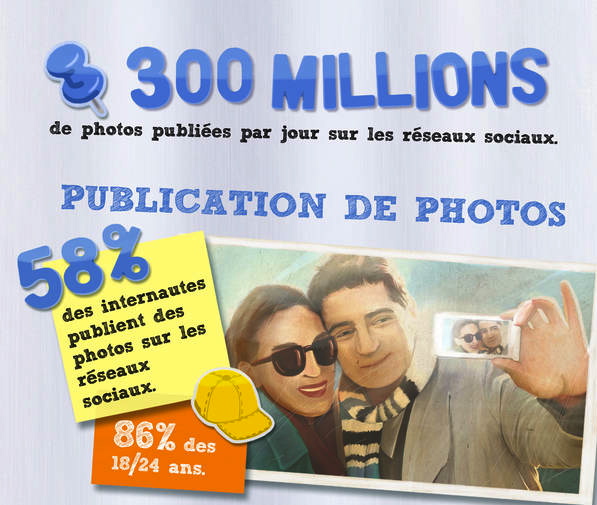
* , summarizes the findings of a study that the CNIL had commissioned on the use of photos in social media.
The study was conducted by TNS Sofres on a national sample of 1554 people age thirteen and up.
The CNIL had commissioned the study in light of the explosion of
photo sharing on social media in recent years. For example, every day,
more than 300 million photos are shared on Facebook alone. In
conjunction with the development of facial recognition technologies and
the searchabilty of online pictures, the stakes for privacy are high.
Here are some interesting numbers:
- More than half of internet users take pictures with the primary purpose of publishing them online.
- 58% of internet users publish pictures online, and the percentage
rises to 86% among the 18-24 age group. 60% of the 18-24 age group
admits searching for pictures of others online.
- 89% of the 18-24 age group has used tagging. 41% of the same age group is worried about this practice.
- 44% of internet users always ask permission of the photographed people before publishing a photo. (that leaves 56% who don’t).
- 43% of internet users have been embarrassed by a picture published
online. In the age group 18-24, this number rises to 61%. For 27% of
that age group, the online publication of pictures already has had
negative impacts in their personal lives.
- 62% of internet users do not know who has access to their pictures, posted online.
- Two out of three internet users declare to want the option of
deleting their pictures at a later date, but three out of four realize
that it might be difficult. Less than 1/3rd of internet users claim to understand the parameters that control the use of their pictures.
These numbers lead the CNIL to conclude that, in the absence of a
clear understanding by the users of the parameters for the use of their
pictures, the responsibility for the protection of privacy should not
only lie with the user, but also with the platforms that publish those
pictures. For example, these platforms should provide their users with
clear tools to manage the life cycle and visibility of users’ pictures.
The lack of transparency in the area of online mechanisms regarding
pictures echoes the general trend of lack of transparency by the largest
internet players, which the CNIL has discovered for example on the
occasion of its audit of Google.
The CNIL warns that, even though innovation often demands breaking
with established rules, a stable business model nevertheless requires
transparency of its policies and the trust of its platform’s users.
It cites the recent Instagram gaffe as an example that illustrates this point.
Advice for Internet Users:
The CNIL posted on its
site a list of simple and practical data protection tools for pictures, posted online.
Some tips:
- Pay attention to the privacy settings of the platform on which you post your pictures.
- Use tagging with restraint and ask permission first.
- Think twice before using the automatic synchronization tools offered
by online platforms: you may want to automatically share some of the
pictures you take with Facebook, but certainly not all of them.
Automatic synchronization will lead to sharing of all pictures, now and
in the future. Once shared, these pictures may be hard to retrieve. (For
example, they may have been shared onward, without your knowledge).
These tips may sound basic to the sophisticated privacy professional,
but it is this author’s opinion, based on her personal experience
online, and now reinforced by the numbers provided by the CNIL’s study,
that they are not superfluous.
Kudos to Isabelle Falque Perrotin for disseminating this important
information on a popular publication such as the Huffington Post.
* La Commission Nationale de l’Informatique et des Libertés, the French Data protection Authority.
December 28th, 2012 by Monique Altheim
- Ediscovery and DataProtection Daily is out!http://paper.li/EUdiscovery/1312257398 … ▸ Top stories today via
@panich52@schestowitz
- Audio Recording Sanction Blues – Many eDiscovery attorneys associate Chicago with 1) the Blues Brothers and 2) Magis…http://ow.ly/2tXQHV
- Blind as a Cat: Lawyers vs. Native Production – I took Introductory Psychology with a phalanx of freshmen in the cav… http://ow.ly/2tXPc
- Employer’s Termination of Non-Union Employees for Facebook Posts Violated NLRA http://ow.ly/2tXKoH
- How
@moniquealtheim Kept You Informed in 2012 on #Privacy,#Ediscovery and #SocialMedia http://ow.ly/gnFUw #e-discovery#dataprotection
- Ediscovery and DataProtection Daily is out!http://paper.li/EUdiscovery/1312257398 …
- How EDiscoveryMap’s Monique Altheim Kept You Informed in 2012 on
#Privacy, #Ediscovery and Social Media http://ow.ly/gnbaX
- Inadequate security of personal, private, and sensitive Information in school districts’ mobile computing devices – … http://ow.ly/2tWWbd
- The Facebook Privacy Setting That Tripped Up Randi Zuckerberghttp://ow.ly/2tWRuf
- They’re guilty of ID theft, but don’t ask the government how/where they got the personal info? http://ow.ly/2tWRue
- Oops. Mark Zuckerberg’s Sister Has A Private Facebook Photo Go Public. http://ow.ly/2tWpcH
- Ediscovery and DataProtection Daily is out!http://paper.li/EUdiscovery/1312257398 … ▸ Top stories today via
@ACLUWill
- Glitch imperils swath of encrypted records http://ow.ly/2tW0iy
- Ediscovery and DataProtection Daily is out!http://paper.li/EUdiscovery/1312257398 … ▸ Top stories today via
@ekotkamp@thepearldream @XeroxCloud
- Ediscovery and DataProtection Daily is out!http://paper.li/EUdiscovery/1312257398 … ▸ Top stories today via
@EUdiscovery@takebackthetech
- Cn: Leaks prompt postal overhaul http://ow.ly/2tUrBy
- Georgetown Part Three: Laughs About Logs and What Judges Don’t Like About You http://ow.ly/2tU5aU
- Ediscovery and DataProtection Daily is out!http://paper.li/EUdiscovery/1312257398 … ▸ Top stories today via
@EUDataPrivacy
- Verizon FIOS allegedly hacked; 300,000 records dumped; more than 3 million acquired? http://ow.ly/2tTFnP
- Ediscovery and DataProtection Daily is out!http://paper.li/EUdiscovery/1312257398 … ▸ Top stories today via
@Baahirezaman@postma
- VA: Fairfax Schools leak: Personal student info will be removedhttp://ow.ly/2tSPdf
- U.S. Banking Regulator Directs Banks to Bolster Cybersecurity Efforts in Wake of Recent Denial of Service Attacks http://ow.ly/2tSGLN
- All I Want For Christmas Are Taxable eDiscovery Costs – Nothing says Merry Christmas like winning eDiscovery costs. …http://ow.ly/2tSGLO
- Congress Approves VPPA Consent Requirement Changes – On December 18, 2012, the U.S. House of Representatives passed …http://ow.ly/2tSF2X
- New Illinois Rules Address Inadvertent Disclosure – On November 28, 2012, the Supreme Court of Illinois entered an o… http://ow.ly/2tSD2j
- New U.S. Security Breach Reporting Requirements Likely for Cleared Defense Contractors http://ow.ly/2tSAcB
- Article 29 Working Party Announces Launch of Binding Corporate Rules for Processors http://ow.ly/2tSAcC
- Federal Law Does Not Preempt California Telephone Privacy Statutehttp://ow.ly/2tSAcD
- And yet another contractor breach http://ow.ly/2tSx1q
- Google Executives Acquitted in Italian Privacy Case – On Friday, an Italian appeals court in Milan overturned the 20… http://ow.ly/2tSlEc
- Note to Samsung: Santa and Smartphone Sex Videos Do Not Mix Well http://ow.ly/2tSiFw
- Senate Passes VPPA Amendment; Bill Heads to President Obama – Last night, the Senate passed an amendment to the Vide…http://ow.ly/2tSeW7
- Ediscovery, Privacy, Data Protection and Social Media Weekly Updates.Stay Informed! http://fb.me/uQPJKPn2
- Your Ediscovery, Privacy, Data Protection and Social Media Weekly Updates is Out! http://ow.ly/ghWYA
December 26th, 2012 by Monique Altheim

A short recap of EDiscoveryMap’s
Monique Altheim‘s
activities in 2012 to help keep her global readers informed and up to
date in the areas of Privacy, Ediscovery and Social Media:
- She spoke on or moderated 11 panels at conferences, from Washington
D.C. and L.A. to Brussels, Belgium, Prague, Czech Republic and Punta
del Este, Uruguay.
- She attended another half a dozen conferences related to Privacy, Ediscovery, Social Media, Cloud and Big Data.
- She posted daily updates on her LinkedIn, Google+ Page and Facebook Page. The Facebook Page
reached readers from the U.S., Canada, Belgium, Brazil, United Kingdom,
Mexico, Iran, Italy, New Zealand, Malaysia, Sweden, South Korea,
Germany, Spain, Israel, Argentina, Congo, Jamaica and Netherlands. The Linkedin
posts reached readers from the U.S., Canada, Belgium, Spain, France,
U.K., Italy, Netherlands,Ireland,Austria,Bulgaria, Sweden, Hungary,
Poland,Russia, Estonia,Czech Republic, Germany, Greece, Portugal,Norway,
Switzwerland, Luxemburg,Finland, Ukraine, Estonia, Uzbekistan, Malta,
Turkey, Cyprus, Israel, Saudi Arabia, Brazil, Columbia, Chile, Peru,
Uruguay, Australia, New Zealand, Pakistan, India, China, Japan,Malaysia,
Nepal,Singapore, Taiwan and Kenia.
- She tweeted thousands of Privacy, Ediscovery and Social Media tweets via her three Twitter handles @moniquealtheim, @EDiscoveryMap and @EUdiscovery
- She posted more than 80 blog posts on her blog EDiscoveryMap. The
blog has a global readership from the U.S and Canada to Europe, Latin
America, Asia and Africa. EDiscoveryMap reaches on average, viewers from
about 55 countries worldwide.
- She created and posted half a dozen power point presentations on her SlideShare site. The slides averaged, to date, about 7,000 views world wide.
- She continued her daily publication of the EDiscovery and Data Protection Daily.
- She created 10 privacy/ediscovey/social media related videos, which she uploaded on her EDiscoveryMap YouTube Channel. Her
privacy, ediscovery & social media videos were watched from the
U.S, Canada, Israel, Morocco, Poland, Ireland, Ukraine, France, Germany,
Belgium, Italy, Netherands, Czech Republic, Uruguay, South Korea, Hong
Kong and India.
- She co-authored the E-book “E-Discovery Legal Issues Guidebook”, published by PenTest Magazine.
- She updated her information sharing mobile app for iPhone/iPad and Android devices
a few times, working on constantly perfecting it and also added a
privacy policy to it. The app has been uploaded from the U.S. &
Canada ,Europe, China, Japan, Taiwan, India, the Middle East and South
America.
- And finally, in a search for continuous improvement of her knowledge
of privacy and data protection, she earned the additional certification
of CIPP/E (Certfied Information Privacy Professional/Europe).
Wishing all a Happy 2013, and looking forward to continue to share
information this coming year via old and new channels and platforms.
December 21st, 2012 by Monique Altheim
December 14th, 2012 by Monique Altheim
December 7th, 2012 by Monique Altheim
In a
speech given at the
3rd Annual European Data Protection and Privacy Conference,
in Brussels on 12/4/12, Viviane Reding addressed the reasons for the
global interest in the European Commission’s proposed reforms to the EU
Data Protection Regime:
“Why is there so much interest in our data protection reform?
…, because data protection is a global challenge. In a world where
borders are increasingly blurred, and where data moves at the speed of
light, the Union’s rules matter beyond its borders. Our debate is a
precursor of future debates in other parts of the world. Many countries
have a new generation of data protection laws in the making, in Asia, in
Latin America, in Africa. In the U.S., the voices of reform are growing
louder. All across the world, people are realising that good data
protection rules are good for growth. This is at the heart of our own
proposals here in Europe.”
But, while the EU may be leading the global data protection reform
movement, there is no doubt in my mind that the US remains the leader in
global data collection technologies.
The U.S. Ediscovery industry originated from the very broad Common
Law requirement of “Disclosure” or “Discovery” in civil litigation. As
digital data became the overwhelming source of data in most companies
and organisations, “discovery” became “e-discovery”, the “e” standing
for “electronic”. This obligation to disclose is practically
non-existant in Civil Law systems.
According to a recent
report
published by Transparency Market Research, the global e-discovery
market was worth USD 3.6 billion in 2010 and is expected to reach USD
9.9 billion in 2017, growing at a CAGR of 15.4% from 2010 to 2017. In
the overall global market, the U.S. is expected to maintain its lead
position in terms of revenue with 73% of global e-discovery market share
in 2017. Another
report,
published by Research and Markets, forecasts the Global eDiscovery
market to grow at a CAGR of 15.56 % over the period 2011-2015.
The globalization of trade and data flows have lead to an increase in
international litigation, with, in Common Law based jurisdictions, the
accompanying need for global data collections to satisfy the Common Law
“Duty to Disclose” in civil litigation.
Just as the EU Data Protection reform has caused undeniable ripple
effects worldwide, the U.S. Edsicovery boom has had an impact on the
global practice of law.
For example, at the recent
LawTech Europe Congress 2012
held in Prague, CZ, on 11/12/12, I was impressed by the overwhelming
interest expressed in U.S. based Ediscovery technologies for application
in local internal and Government investigations in bribery, corruption
and fraud allegations within EU companies, and, to a lesser extent, for
application in cross-border ediscovery procedures.
It is in the particular case of cross-border ediscovery, conducted in
the context of U.S. civil litigation, that the clashes between local,
EU-style data protection regimes and the need for transfer of data to
the U.S., are the most acute and problematic.
In order to solve this very complex problem, I believe, in line with the
Sedona Conference‘s
philosophy, that dialogue is of the utmost importance. In the case of
U.S. cross-border ediscovery in the EU, this dialogue takes on the
additional dimension of a dialogue between two vasltly different legal
systems: the Common Law system of the U.S. and the Civil Law system of
the majority of EU member states. These different legal systems are
cause for many misunderstandings between EU and US legal
practitioners. On the one hand, U.S. attorneys and judges need to become
more familiar with the EU Data Protection regime, and on the other
hand, the EU member states’ attorneys, in-house counsel and Data
Protection Authorities (DPAs) need to become more familiar with U.S.
ediscovery obligations.
In the past, I have explained basic EU Data Protection concepts to U.S. legal practitioners.
At the
LawTech Europe Congress 2012, I attempted to explain U.S. Ediscovery principles to an audience, consisting mainly of Civil Law practitoners.
The Sedona Conference Working
Group 6, of which I am an active member, has worked relentlessly to
achieve a dialogue between the EU Data Protection Authorities and US
attorneys, in-house counsel and Federal Judges. It has published The
Sedona Conference International Principles on Discovery, Disclosure and
Data Protection in December 2011, which is now open for public comment.
The Principles were very well received by the Article 29 Working Party,
the EU Data Protection Authorities’ Advisory Body, presided over by
Jacob Kohnstamm.
It is the hope of The Sedona Conference that its International
Principles will become accepted as best practices, as a code of conduct
by U.S. litigants and Judges, as well as by EU member states’ DPAs.
To paraphrase Viviane Reding: ..because litigation is a global
challenge. In a world where borders are increasingly blurred, and where
data moves at the speed of light, U.S. ediscovery rules matter beyond
their borders.


 Jan Philipp Albrecht